CSAS News: 2008/2009
•2008/2009 Summary to-date
• Schmidt Building
• CSAS and Collaborators Perform CODOS Fieldwork throughout Colorado Mountains in Spring 2009
• Hans-Peter Marshall Conducts Radar Field Camp in March 2009
• CSAS Hosts AIARE Level III Avalanche Professionals Course in March 2009
• CSAS Hosts Minnesota State University - Mankato Field Camp
• CSAS Hosts Dr. Christine Pielmeier, of the Swiss’s WSL Institute for Snow and Avalanche
Research SLF, in Davos, for Week-Long Field Campaign
• Stormy Early Winter Weather
• K-12 Kids Study Mountain Weather at Swamp Angel Study Plot
• CSAS Executive Director presented a poster titled “Applying Dust-on-Snow Research to Colorado Water
Management” at the American Geophysical Union’s Fall Meeting 2008, in San Francisco.
• CSAS Designs and Builds PV Array for Marshall Radar Research
• CSAS Conducts GPS Survey of SBBSA Infrastructure
• Steltzer & USFS Ouray Ranger District Staff Wrap Up Advanced Snowmelt Experiment
• Ed LaChapelle Library Arrives in Silverton
• Archived News Items
• Most Recent News Items
2008/2009 Summary
During summer 2008 the CSAS hosted a very successful study by Dr. Heidi Steltzer (Colorado State University) near the Senator Beck Study Plot. Our Forest Service Ouray Ranger District staff visited the project site and helped dismantle Heidi’s project in August. Later that summer the CSAS did a precision GPS survey of our facilities in Senator Beck Basin and also installed a large photovoltaic power array for Dr. Hans-Peter Marshall (Boise State University) at our Swamp Angel Study Plot. Local schools groups visited the Swamp Angel Study Plot in late fall and then used data from the site in their classrooms over the winter. Marshall conducted two field campaigns during the winter, the first with his collaborator from Switzerland, Dr. Christine Pielmeier, and the second with his British collaborator Dr. Nick Rutter. Winter2008/2009 produced several major snow storms as well as the most intense and dramatic dust storms in the collective memory of several generations of ranchers, water managers, snow workers, weather observers, and others throughout western Colorado. Our Colorado Dust-on-Snow Program, in collaboration with Dr. Tom Painter (University of Utah – Snow Optics Laboratory) was instrumental in monitoring that dust and apprising regional state and federal water managers, in advance, of what did prove to be an exceptionally early and intense snowmelt runoff season in most of Colorado’s mountain watersheds. CSAS did feel the effects of the national economic crisis of 2008/2009, particularly with respect to our attempt to secure a Center facility in Silverton through a lease/purchase opportunity. Meanwhile, the CSAS and our work on dust-on-snow received considerable national and international press attention, and our proposal to fund an international workshop on snow impurities in 2010 was funded by the National Science Foundation.
Ed LaChapelle Library Arrives in Silverton
After consultation with his survivors, considerable planning and facilitation by Don Bachman, president of the CSAS, and a very long U-Haul trip from McCarthy, Alaska to Bozeman, Montana by Ron Matous, the personal library of Dr. Edward R. LaChapelle made the final leg of its journey to Silverton via US Mail, arriving in July. Some 70 boxes of materials were immediately placed inside the San Juan Historical Society Archive facility for safekeeping for subsequent cataloging and curation at that facility.
ELC_1 Silverton Postmistress Donna Perino and friend of the CSAS Everett Lyons load boxes into the CSAS’s vehicle for transport to the Archive facility.
ELC_2 CSAS’s Andrew Temple takes the first load of boxes into the Archive.
ELC_3 San Juan Historical Society president Bev Rich, and 3rd generation Silvertonian Jim Cole, both of whom knew Ed, make a load.
 Steltzer & USFS Ouray Ranger District Staff Wrap Up Advanced Snowmelt Experiment
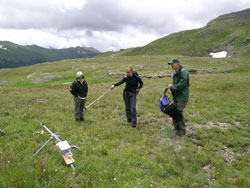
Dr. Heidi Steltzer explains her plant phenology monitoring equipment to Warren Young and Kelley Liston from the US Forest Service Ouray Ranger District, our “landlord” at Senator Beck Basin. The Senator Beck Study Plot is visible in the background. Heidi concluded her project that day, August 8th, 2008, by dismantling and removing these “mantis” arrays from the Basin. Results of her study regarding the effects of early snowmelt on plant life cycles, conducted in collaboration with the CSAS, were subsequently published in the Proceedings of the National Academy of Science in spring 2009.
CSAS Designs and Builds PV Array for Marshall Radar Research
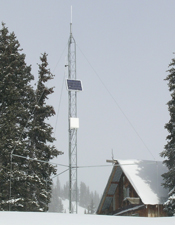
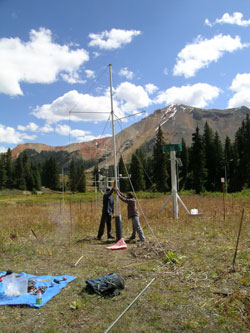
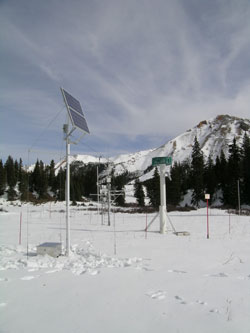
In order to provide an independent and adequate source of power for his “FMCW” snow-penetrating radar research, Dr. Hans-Peter Marshall, from Boise State University, contracted the CSAS to design and build a 240 watt photovoltaic array, with a 400 amp-hour battery bank, at our Swamp Angel Study Plot, with US Forest Service permission. Michael Barton and Andrew Temple are seen preparing to lower the 22’ pipe mast into a 3’ hole. The completed array began charging a 400 amp-hour battery bank on November 20th, 2008.
CSAS Conducts GPS Survey of SBBSA Infrastructure
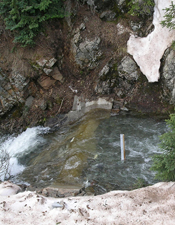
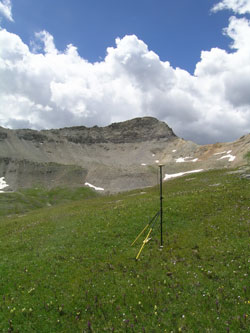
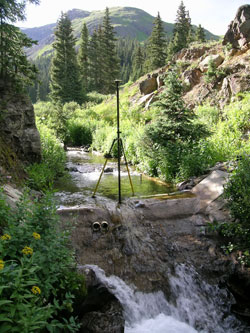
In August 2008 the CSAS conducted a “mapping grade” GPS survey of its Senator Beck Basin research infrastructure. Many thanks to UNAVCO, of Boulder, Colorado for providing the required equipment, on loan, at no cost. Some 44 points in our Senator Beck Basin plant community monitoring program were surveyed, as were our instrument arrays and our stream gauging station, seen here.
Schmidt Building
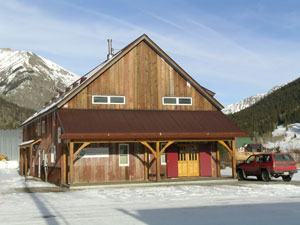
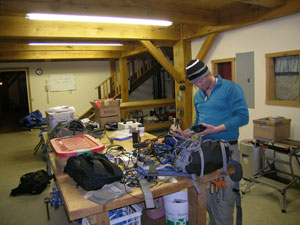
After several years of discussion, in 2008 the CSAS and the Schmidt family, of Silverton, collaboratively developed a lease and purchase strategy that both parties hoped would enable the CSAS to occupy and ultimately acquire the Schmidt’s near-new 4,400 square foot timber frame building on 12th Street, adjoining the narrow gauge railroad tracks where they enter “downtown” Silverton. The CSAS had recognized the attributes of this particular building many years earlier and the facility immediately proved its capabilities in meeting our needs, providing heated and lighted shop space for instrumentation projects such as the Marshall photovoltaic array (as compared to the unheated, unlighted, 10’ x 10’ storage unit we previously rented), classroom spaces for small and larger groups, ample office space (as compared to our 10’ x 10’ office in the Miners Hospital), a library space, dry and clean storage spaces for gear, materials, and supplies, and living quarters for CSAS staff. Unfortunately, the timing of this opportunity could not have been worse, given the subsequent severe national recession, and the CSAS’s board of directors determined in early summer 2009 that it was necessary to withdraw from the Schmidt’s facility and relocate to a smaller facility in Silverton, thus assuring our survival under the extremely difficult funding climate experienced by non-profit organizations throughout the country. While our tenure there was fleeting, we retain fond memories of the building and our activities and guests there.
|
|
The Schmidt Building at 321 East 12th, Silverton. |
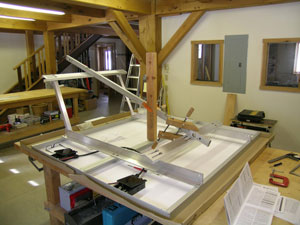
Pre-assembling the solar panels for Dr. Hans-Peter Marshall’s Swamp Angel Study Plot array.
|
|
|
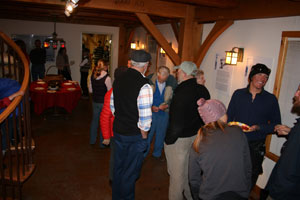
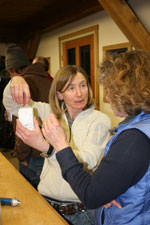
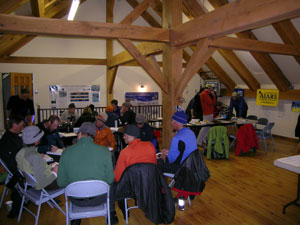
During the CSAS’s community Open House, January 29, 2009 – photo courtesy of Karen Hoskin. |
Dr. Christine Pielmeier, of the Swiss’s WSL Institute for Snow and Avalanche Research SLF, in Davos, discussing her work with Silverton residents during our Open House – photo courtesy of Karen Hoskin.
|
|
|
Hans-Peter Marshall gearing up for his Senator Beck Basin field campaign in January, 2009. |
Denny Hogan, local US Forest Service Snow Ranger, discusses ski area avalanche hazard management with a class from Minnesota State University – Mankato in the Schmidt facility during their field camp in Silverton, hosted by the CSAS. |
CSAS Hosts AIARE Level III Avalanche Professionals Course in March 2009
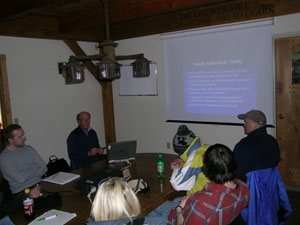
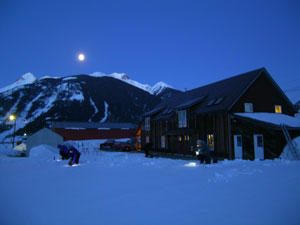
From March 9-14, 2009 the CSAS provided our Schmidt building facility to the American Institute for Avalanche Research and Education (AIARE) for their Level III class of 22 avalanche professionals from throughout North America. Days began before dawn with weather observations just outside the building, followed by lectures and planning sessions inside, and often ended with additional lectures or discussions in the evening, following daily field excursions.
|
|
Pre-dawn weather observations outside the Schmidt building. |
Field session planning inside the Schmidt building.
|
K-12 Kids Study Mountain Weather at Swamp Angel Study Plot
Students and teachers from the Ouray Middle School, Montrose High School, and Telluride High School visited the Swamp Angel Study Plot and Senator Beck Stream Gauge sites during the fall and winter of 2008 and then used near-real-time data from those sites as a vehicle for studying mountain weather, climate, and snow hydrology in their classrooms later that winter and spring. We thank Mountain Hardwear’s Gives Back Program for facilitating this program, and enabling the CSAS to offer those study site data to teachers anywhere, via the CSAS’s CURRENT CONDITIONS webpages.

Ouray 5th and 6th grade students troop into the Swamp Angel Study Plot on October 23rd to see, first hand, a “real” weather station and the Senator Beck Stream Gauge, before snow arrived.
CSAS Executive Director presented a poster titled “Applying Dust-on-Snow Research to Colorado Water Management” at the American Geophysical Union’s Fall Meeting 2008, in San Francisco.
The session, titled “Bridging the Gap between Science and Decision-Making”, was a part of the Global Environmental Change session, just one of dozens of sessions during this annual, week-long, international conference attended by some 14,000 researchers and graduate students from around the globe.
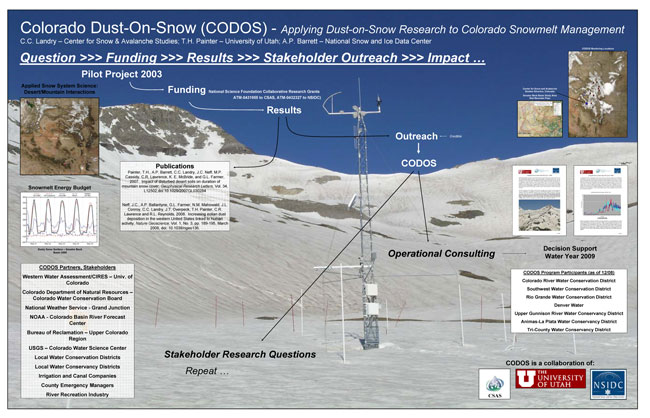
Link to a PDF of the poster here and link to Pubs page. The poster PDF file is: AGU_Landry_GC33b_2008_Poster
Stormy Early Winter Weather
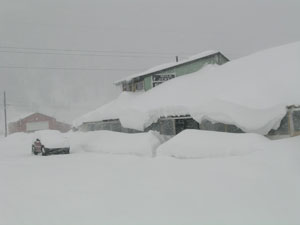
Between November 27 and December 27, 2008 our Swamp Angel Study Plot received seven “numbered” winter storms totaling 255 mm of water equivalent (10” of water), raising the snowpack from 30 cm deep to 178 cm deep. December 2008 also proved to be the windiest month in our five-year history at the Putney Study Plot, with 14,741 “miles of wind” recorded, the total of over one-half million measurements of speed and direction, made every five seconds. The effects of all that wind were felt in Silverton, where roof shovelers were in constant demand.
|
|
Greene (Main) Street on Christmas Day, 2008. |
A shop on our street on Christmas Day, 2008. |
CSAS Hosts Minnesota State University - Mankato Field Camp
Dr. Don Friend made yet another pilgrimage with students from Minnesota State University at Mankato to Silverton for a field class in February, 2009. And, sustaining the tradition established by his graduate school advisor at Arizona State University, Dr. Mel Marcus, students spent plenty of time in the snow, learning and practicing snowpack observation techniques together in large snowpits.
|
|
Refilling the pit |
Measuring snow water equivalent (SWE). |
|
Dr. Friend (second from left) and students in a snowpit. |
CSAS Hosts Dr. Christine Pielmeier, of the Swiss’s WSL Institute for Snow and Avalanche Research SLF, in Davos, for Week-Long Field Campaign
In late January 2009 Dr. Christine Pielmeier, a staff scientist and avalanche forecaster at the Swiss’s WSL Institute for Snow and Avalanche Research SLF in Davos, came to Silverton for a week fieldwork. She, along with her collaborator Dr. Hans-Peter Marshall from Boise State University, brought and deployed an impressive amount of very high-tech equipment capable of making tens of thousands of precision measurements of snowpack properties at scales ranging from microstructural texture and strength at the individual snow grain scale, to snowpack layering over multi-kilometer transects of the Senator Beck basin Study Area. Traditional “low tech” methods for characterizing and testing snowpack stability were performed in a grid of snowpits surrounded by high tech measurements using the Swiss’s “Snow Micro-Pen” motorized ram resistance sensor and Marshall’s “FMCW” snow-penetrating radar system. Several long, hard days of fieldwork at both sub-alpine and alpine sites produced a rich dataset for subsequent spatial and other analyses designed to tease out the ability of the high tech equipment to detect snowpack properties revealed by the lower tech snowpit observations and traditional stability tests.
|
|
Day 1 of the campaign was spent on a small slope adjoining the CSAS’s Swamp Angel Study Plot. Chris Pielmeier is seen operating the Swiss Snow Micro-Pen instrument as Hans-Peter Marshall and his assistant Andy Gleason prepare an adjacent snowpit. |
After completing her high-tech, motorized Micro-Pen measurement, Chris performed an adjoining profile of the same snowpack property – resistance to penetration – using the time-tested, low-tech Swiss Ram approach, a pointed tube driven down through the snowpack by drop-hammer blows.
|
|
|
Once they had completed these measurements and a series of stability tests in four snowpits, Hans-Peter and Andy made radar measurements in a carefully spaced series of traverses across the slope, collecting hundreds of detailed snowpack profiles for comparison to both the manual snowpack profiles and the Micro-Pen and Swiss Ram profiles. |
The sampling scheme employed near the Swamp Angel Study Plot was later repeated in alpine terrain near the Senator Beck Study Plot. Chris is seen using her avalanche probe to preview snowpack depths across this small slope while under close spotting by the rest of the team. Stability sampling requires finding small slopes like this, with non-threatening terrain above and below the slope, since the loading on the snowpack by a large team is substantial. Even then, one person always remained off the slope, in a spotting position, while the team performed its work.
|
Hans-Peter Marshall Conducts Radar Field Camp in March 2009
In March 2009 Dr. Hans-Peter Marshall returned to Silverton for another intensive field campaign in Senator Beck Basin, collecting literally millions of snowpack profiles throughout the Basin with his highly portable FMCW snow-penetrating radar system.

Hans-Peter Marshall and Andy Gleason, his long-time partner in these radar campaigns, begin making measurements as soon as they leave the parking area, climbing uphill on skis with climbing skins, side-by-side, sometimes for hours, with the radar system deployed on a pole between them. Here they are seen approaching treeline on the way to the Senator Beck Study Plot. A precision GPS antenna is seen protruding from Andy’s pack, capturing precise location information for each radar profile, on the fly.

The radar team regroups at Senator Beck Study Plot – Dr. Jeff Deems (right foreground) and PhD student James McCreight (on left with back to camera) are also routine members of the radar team.

In addition to his radar measurements, HP is seen here taking a near-infra-red (NIR) image of a snowpit wall at the Senator Beck Study Plot. This technique was presented by HP and Dr. martin Schneebeli in a small workshop for researchers hosted by the CSAS in March 2008. Details in these images can be compared with snowpack properties detected by HP’s FMCW radar and other observations regarding snow density and other properties.
CSAS and Collaborators Perform CODOS Fieldwork throughout Colorado Mountains in Spring 2009
The consensus throughout Western Slope of Colorado by June was that the spring of 2009 was an extraordinary dust-on-snow season producing more and larger events than anyone, going back several generations, could recall. While anecdotal, and not verified by hard data (since no one before our team has previously made rigorous observations), we do not dismiss those The CSAS’s Colorado Dust-on-Snow program team led by Chris Landry and his field assistant Andrew Temple, in collaboration with Dr. Tom Painter from the Snow Optics Laboratory at the University of Utah, and his graduate students McKenzie Skiles (MSc student) and Annie Bryant (PhD candidate), was literally “all over the place”, making several 1,000 mile “laps” around the Colorado mountains to observe and sample the (up to) 12 layers of dust present throughout the State’s mountains. Here are some snapshots from those trips …
Pics: CODOS_1 Sunset at Spring Creek Pass on our first excursion to the ten additional sites where we monitor dust-in-snow around the Colorado Mountains. The snowpit here is seen, faintly, down and to the right of the sign.
CODOS_2 Our April tour happened to intersect with a ferocious “up-slope” blizzard on the Front Range of Colorado on April 17, resulting in “difficult” conditions for fieldwork (here at Berthoud Pass) and considerable driving challenges including avalanches over the highway.
CODOS_3 Tom Painter is seen here putting the finishing touches on our April snowpit at Rabbit Ears Pass.
CODOS_4 Annie and McKenzie showing off the evidence in the Rabbit Ears Pass snowpit wall of their superbly executed set of dust-in-snow samples.
CODOS_5 Annie, McKenzie, and Andrew on May 12, 2009, en-route to upper Senator Beck Basin for dust-on-snow sampling and field spectrometry measurements. Their heavy packs are belied by the smiles on a beautiful spring day.